Historical Notes on Koh Yao Noi
I wrote this small text about 15 years ago when I settled on Koh Yao Noi. At that time, I was conducting historical and ethnographic research on southern Thailand, its peoples and cultures, in partnership with Sorbonne University, the French Ministry of Foreign Affairs, and the University of Songkla Nakarin, Patani.
I was particularly interested in how the Malay Peninsula had been, over the last two millennia, a crossroads of cultures—a hub for trade between India and China, and later with the Western world—and how aborigines and local civilizations interacted and exchanged, both culturally and economically. Well, there would be a lot to tell, but that would take many more papers.
So, having a fairly good knowledge of the region’s historical background, I wrote this introductory page and shared some paragraphs on Wikipedia, a few blogs, and other websites. The page has since been moved to Wikitravel (link).
The funny thing is that now, this text is partially—and sometimes mistakenly—reproduced on many hotel websites… of course, never crediting the original author :-)
In a way, it’s cool—at least it gives an almost correct idea about the place travellers are coming to when landing on Koh Yao. On the other hand, it’s a little frustrating (though not surprising) to see how businesses grab content from others, and that no one ever tried to push the topic a little further…
Here is the original paper:
The Original Text
“Koh Yao Noi is one of the larger islands in Phang Nga Bay, an archipelago of 44 islands. It is easily accessible from both Phuket and Krabi Provinces and offers some of the most beautiful sea scenery in Southeast Asia.
Sea Gypsies (Moken people) were inhabiting the bay before anyone else—except maybe other nomadic people like forest hunters and collectors (Sakai, Negritos).
The 3,500 or so inhabitants of Koh Yao Noi are thought to be recent migrants from the Malay Peninsula (Satun, Trang). The Mon population—linguistically and culturally part of the Khmer ethnolinguistic group—has been settled in peninsular Thailand since ancient times, ruling maritime states like Ligor (Nakhon Sri Thammarat). They have continuously merged with southern migrants from Malaysia and northern rulers (Thai) over centuries of trade and political conflict. Most probably, Mon ancestry remains prevalent among people living in southern Thailand today, including those of Koh Yao.
Numerous cave paintings hidden in the many islands of the bay, dating from 2,000 years ago to the last century, attest to the influence of distinct communities in the emergence of a mixed-origin population now inhabiting the provinces of Phang Nga, Phuket, Krabi, and Satun.
The most recent migrations (17th–18th centuries) from Satun and Trang to Koh Yao Yai and Koh Yao Noi are evidenced by the fact that the particular dialect spoken on the islands still bears obvious Malaysian lexical traces, particularly in toponyms and the vernacular names of flora species.
The main industries on the island are fishing and rubber planting. A little rice farming and some fruit, palm, and coconut plantations are also evident. Boat building and farming techniques here have been passed from father to son and, while some of the younger generation leave Koh Yao to seek the bright lights of Phuket, most return to their tight-knit community.” — G. C., 2000.
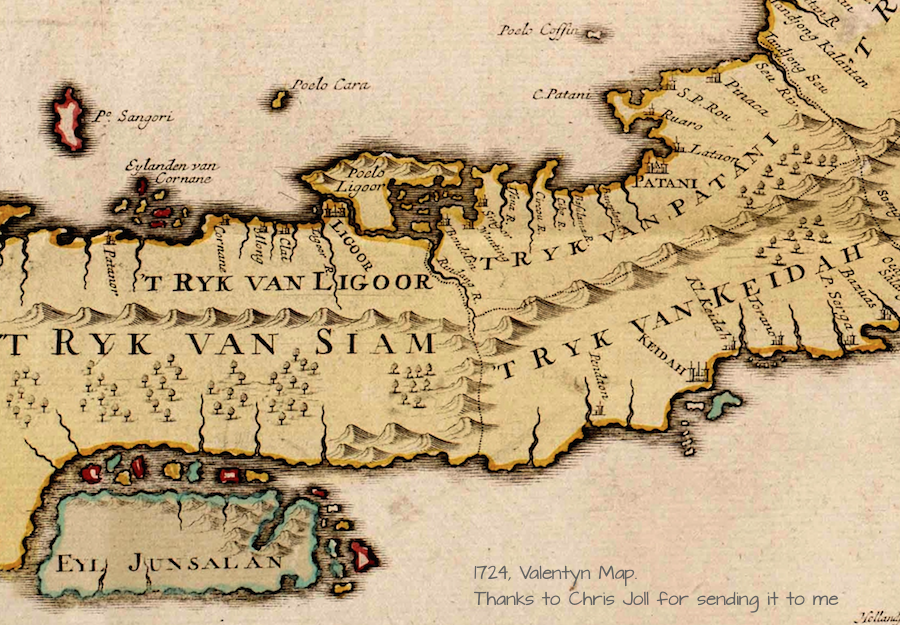
Illustration
An old map by François Valentijn, who was employed by the Dutch V.O.C., published in 1724 in Oud en nieuw Oost-Indiën, vervattende een naaukeurige en uitvoerige verhandelinge van Nederlands mogentheyd in die gewesten, benevens eene wydluftige beschryvige der Moluccos … en alle de eylanden onder dezelve landbestieringen behoorende; het Nederlands comptoir op Suratte, en de levens der Groote Mogols…
Thanks to Christopher Joll, Social Anthropologist at Chiang Mai University, for giving me a copy of this map.